


Liline Arends
Consultant
Lilline is an innovation consultant with a passion for change and transformation. She helps organisations uncover opportunities, harness new technologies, and inspire teams to think creatively and differently. Her strategic insight and hands-on approach make her a valuable partner for companies looking to grow and prepare for the future.

Tim Legerstee
Manager
Tim helps clients develop their commercial strategy. Whether that involves optimising their recurring revenue model, refining their pricing strategy, or sharpening their market focus. He thrives working with innovative, mission-driven companies that are making a positive impact on the world.
Share this article
Cover image: Schiphol Airport
The energy transition at Schiphol did not begin out of acute necessity. There was no immediate network congestion, no financial incentive, and no operational crisis. What there was: a growing awareness that the status quo was unsustainable if Schiphol wanted to achieve its sustainability goals.
Electrification – including on the Airside – was increasing, sustainable ambitions were becoming more concrete, and initiatives within the organisation were multiplying. However, mutual coherence needed improvement. Energy was regarded as a sustainability issue, but at the time not yet as an explicit precondition for operations. This made the situation vulnerable.
Together with nlmtd, the Acceleration Team Energy (ATE) was therefore established. Not as a new department, but as a platform that steers energy transition initiatives to drive acceleration.
Many good initiatives, but no overview
A great deal was already happening within Schiphol in the areas of energy and sustainability. But almost everything originated from silos – logically organised, well-intentioned, but lacking an integral perspective.
The urgency was difficult to feel. Grid congestion did not become a factor until later. Cost was not an explicit driver. On top of that, an extensive programme was already in place to expand the existing network, which resolved problems in the short term. As a result, the urgency for energy direction was hard to quantify and communicate.
Yet the ATE held a clear conviction: without direction, Schiphol will inevitably run aground. Not because of one wrong decision, but due to the absence of an interplay between supply and demand capable of making system-optimal choices.
Organizing direction without breaking existing structures
The Acceleration Team Energy deliberately started small. No formal mandate, no new governance layer, no intervention in ongoing projects. And it was precisely this that made it possible to get started.
The team focuses on coherence: across the chain, across departments, and especially beyond classic project logic. Not by initiating new installations or projects, but by clarifying who decides what, what information is needed to do so, and how decisions are interconnected.
That position was sometimes uncomfortable. The ATE had no formal decision-making authority or budget control only a substantive narrative. But it was precisely because of this that it could function as an accelerator rather than a competitor to existing structures.
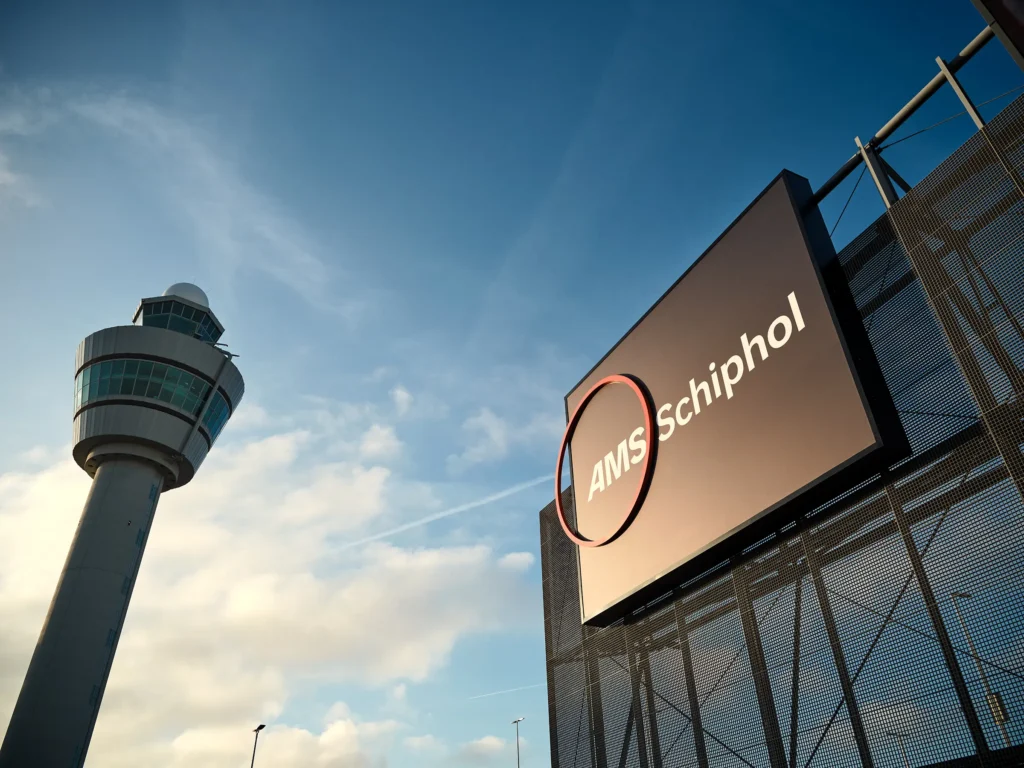
Image: Schiphol
From resistance to movement
Accelerate where you can, slow down where you must
The collaboration between Schiphol and nlmtd was constantly a matter of pace. In terms of content, it was often possible to think further ahead than the organisation could absorb. That required knowing when to shift gears.
Sometimes that meant slowing down to maintain buy-in. Sometimes it meant seizing momentum. For example, when grid congestion became a concrete reality and projects could no longer secure additional power.
Gradually, the conversation shifted. The ATE consistently positioned energy as a critical asset for Schiphol’s operations, not merely as a sustainability ambition. Through these targeted interventions, that insight began to emerge organically within the silos themselves — without the need for top-down direction.
What the ATE achieved
The conversation has shifted
The most important outcome is not one concrete project, but a fundamentally different way of looking at things and a genuine sense of urgency. The question is no longer whether energy transition is necessary, but how it should be structurally organised.
Concretely:
- Integral energy issues now have a permanent place within the ATE
- Organisational and data challenges are not an afterthought, but sit at the heart of the transition: who is in control, who decides, and based on what insights
- Existing programmes incorporate questions about energy management (generation and consumption) early in the process
- Silos are beginning to seek coherence themselves
Direction without authority
By taking an integral view of ongoing projects, the ATE identified which elements are critical to the energy transition: reducing consumption, smart energy management, local generation, and a grid design and commercial structure that provides the right incentives. The ATE pinpointed gaps in projects and investments across these elements, and pushed the organisation, within existing structures, to launch targeted initiatives.
Why it works within a complex organisation
The ATE operates in an advisory capacity, not in the seat of project development, and not within existing governance lines. This is precisely what enables it to help prepare decisions more effectively.
Infrastructure, Commercial, and Sustainability (SUS) are increasingly finding common ground on energy issues. Not because they are formally required to, but because it is substantively necessary to resolve congestion. That is perhaps the most significant shift.
What other organisations can learn from this
- Don’t wait until urgency becomes undeniable.
- Connect to existing structures rather than reorganising everything.
- Start small and demonstrate that progress is possible.
- Build coalitions of people with the right mindset.
- Don’t focus immediately on new assets — first focus on working effectively and managing what is already there (with an emphasis on organisation and data).
The biggest pitfall is continuing to think in terms of projects. A project can succeed while the transition stalls. Acceleration requires explicit direction of the whole.
Looking Ahead
From acceleration to the new normal
The Acceleration Team Energy is not an endpoint. It is a temporary accelerator. Working toward a future where energy efficiency is firmly embedded within the line organisation.
The period ahead will be defined by that embedding. Alongside concrete projects, such as micro smart grids, attention to data and organisation is growing. The goal is for energy efficiency to become a matter of course at Schiphol within the coming years.
Not as a separate programme, but as a way of working.
Interested in how we can support your organisation in the field of energy and sustainability? Get in touch with Pieter Paul, Lilline, or Tim. We would love to think along with you.


