



Marthe Posthumus
Consultant
Marthe Posthumus is a pragmatic and impact-focused consultant who looks at issues in a creative and analytical way. With her background in innovation and data and experience with strategy, innovation, sustainability, data analysis and process optimization, she can approach projects in a strategic and analytical as well as operational and practical way. Marthe enjoys analyzing complex subject matter and translating it into visually appealing concepts. Her ambition is to help companies become future-oriented and thereby accelerate the transition to a sustainable world.

Kasja Oostindie
Consultant
Kasja is enthusiastic about guiding companies in the transition to a circular economy. With her experience in impact assessments, training, program management and process optimization, she brings a comprehensive set of skills to every project. She has an eye for detail and with her data driven focus she supports organizations in achieving their (sustainability) goals.
Share this article

There is still much room for improvement in making the Dutch electronics chain circular. A third of small electronics still end up in ‘regular’ waste, and new products consist of only 15% secondary materials. This is according to research by nlmtd commissioned by Invest-NL. Further progress requires collaboration throughout the chain to make circularity scalable and investable.
The Netherlands has set itself the goal of having a fully circular economy by 2050. Consumer electronics play a key role in this: previous research shows that electrical and electronic devices are responsible for almost half of the climate impact of consumer goods.
Small consumer electronics – think smartphones, laptops, monitors and small household appliances – also make up the fastest growing stream of e-waste. Herein also lies an opportunity, as these very products contain many valuable and critical raw materials.
Invest-NL therefore wanted more insight into the material flows of small electronics. The financing and development institution engaged nlmtd to conduct a study. For the first time, the consultancy drew a comprehensive and quantitative picture of the material flows of small electronics: from inflow and use to disposal, reuse and recycling. The study was conducted by Marthe Posthumus and Kasja Oostindie.

Source: InvestNL, nlmtd
The chain of small consumer electronics still appears to function primarily in a linear fashion. Only 15% of new electronics entering the Dutch market in 2024 consists of secondary materials. This mainly involves steel, which is relatively easy to recycle.
The market for reuse – repair, used and refurbishment – still remains relatively small. Based on previous research, it is estimated to be about one-fifth of electronics (both large and small) entering the market.
Refurbishment is on the rise, but is limited to more expensive devices such as smartphones. “Products under a hundred euros are hardly ever repaired,” says nlmtd consultant Kasja Oostindie. “With the high Dutch labor costs, it’s very difficult to make that profitable.”
A third in the trash can
Of all discarded small consumer electronics, 44% are treated circularly. “The Netherlands has an effective collection network and a well-developed processing infrastructure, resulting in a relatively high percentage of collected waste being recycled,” the researchers write.

Source: InvestNL, nlmtd
This efficient processing infrastructure does have a downside, Oostindie argues: “We are among the absolute world leaders when it comes to collection for recycling, but the chain is so strongly geared to it that it hinders reuse: as soon as something is destined as waste it is treated as such, and it breaks down during transport, for example. A shame, because reuse is ultimately better than recycling.”
Existing legislation also sometimes works against this. “We therefore recommend that in addition to the standards and certifications that apply to the processing of electronic waste, less complex pathways should be established for the reuse and repair of end-of-life electronics in order to promote recovery and reuse.”
Another major challenge is that a large proportion of electronics does not reach the recycling chain at all: a third (32%) ends up in “ordinary” residual or commercial waste. Consumers mainly throw away small household appliances and cables, due to their size and low value. The researchers recommend stronger encouragement and enforcement of proper disposal of discarded electronics.
Critical materials
There is also room for improvement within the recycling process, including in the recovery of critical materials – a topic that is becoming all the more urgent against the backdrop of rising geopolitical tensions and the push for an autonomous Europe.
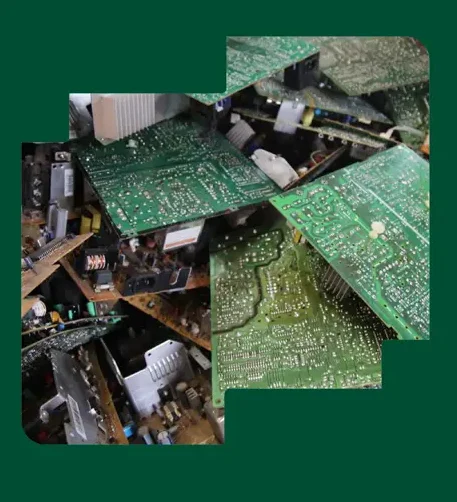
Most critical materials are found in printed circuit boards (PCBs – printed circuit boards), including copper, palladium, platinum, nickel, titanium, manganese, antimony and silicon. Of all the materials in PCBs, more than one-third (36%) are recovered.
However, this almost entirely (35%) involves copper, iron and aluminum. Consequently, a significant portion of the 29 critical materials in electronic waste are “not recovered or recovered very little,” the study shows.

Source: InvestNL, nlmtd
“You can see a problem here that is prevalent in many places: there is not yet a strong business case,” Oostindie says. “Which in the case of critical materials is quite striking, given the scarcity. However, a recycling plant has to focus on something, and then you see that in practice they usually choose valuable materials like gold, silver and palladium. The rest is then lost in the process.”
If the Netherlands wants to recycle more critical raw materials, the researchers recommend focusing initially on one or a few critical materials. “That way you can more easily create additional demand for those and develop the necessary technology so that you can build a strong business case.”
Reduce, extend and close
All in all, nlmtd concludes that the Netherlands is certainly taking steps toward circularity, but also still faces major challenges: “The chain is currently geared primarily toward economic growth rather than value preservation, so it continues to function largely in a linear fashion.”
The recommendations for moving from linear to circular can be divided into three solution directions: reducing and improving resource use, extending useful life and closing cycles.

Source: InvestNL, nlmtd
Overall, achieving the 2050 goal will require systemic change – and thus commitment and coordination from all parties in the chain: “Producers, retailers, repairers, collectors and governments must actively cooperate, effectively deploy financial incentives and regulations, and scale up technological solutions,” the authors say.
At the front end of the chain, the new ESPR (Ecodesign for Sustainable Products Regulation) may start to accelerate. With the regulation coming into force in mid-2024, the EU aims to promote circularity by setting requirements for the design, repairability and lifespan of products.
“For real progress, however, it is important that manufacturers integrate ESPR into their design chain and not just focus on compliance,” Oostindie argues. “The recommendations we make in the report are consistent with this: circular product design and the use of secondary materials should also be encouraged by financial incentives.”
Building on initiatives
Achieving improvement can in many cases build on existing initiatives. For example, the Long Live Electronics coalition is already conducting research into making return logistics damage-free, where currently much value is still unnecessarily lost.
“This is just one example of the many wonderful initiatives already underway,” Oostindie states. “These certainly offer starting points for further improvement. To achieve the high ambitions, they will still need to be scaled up considerably.”
“Above all, the chain will have to work better together,” she concludes by indicating. “We hope our report contributes to that. For the first time, there is now a complete overview of where we are as a chain, and with it a better picture of what is still needed to become circular.”
The study is based on data from various parties, collected with the help of OPEN Foundation and Unitar (SCYCLE), and on fifteen semi-structured interviews. Curious about the entire report? You can find it here.


