


Market Research: Our partnership with Schiphol Airport for aviation innovation
Challenge
For Schiphol’s Innovation Runway program, we were presented with the following challenges:
- Challenge 1: Reducing emissions: detecting APU usage for sustainable airside operations.
- Challenge 2: Testing the first autonomous shuttle service at Schiphol Airport.
Result
nlmtd tech discovery developed three viable solutions to improve baggage handling at Schiphol Airport, each with a detailed implementation roadmap. This gave them concrete options for deploying automation and improving working conditions.
Customer
Schiphol is the largest airport in the Netherlands and offers extensive facilities and services for travelers.
In brief
As Schiphol Airport’s open innovation partner, we helped address baggage-handling challenges that affect working conditions and are critical to the automation goals for 2050.
nlmtd tech discovery is the open innovation partner and ecosystem director of the Royal Schiphol Group (RSG) and supports the realization of the 2050 mission Connecting Your World. To meet employees’ needs for improved working conditions, Schiphol aims to enhance baggage-handling operations. To gain a comprehensive view of market developments, technology maturity, and potential future directions, we evaluated new solutions, researched emerging technologies, and analyzed market trends.
Challenge
Royal Schiphol Group aims to operate the world's most sustainable and leading airport by 2050.
The Royal Schiphol Group is leading the development of autonomous airside operations by enhancing its shuttle services. This research focused on evaluating potential Autonomous Guided Vehicles (AGVs) that meet the necessary specifications to navigate the various airside routes at Schiphol Airport.
The findings led to a successful Proof of Concept (PoC) for Schiphol’s first autonomous shuttle service, an important step toward improving operational efficiency and sustainability in airport logistics. Read more about the ongoing PoC project here.
Result
Three feasible solutions for improving the baggage handling process at Schiphol Airport, each provided with a detailed implementation roadmap. These solutions provided Schiphol with concrete tools to deploy automation and improve working conditions.
- Autonomous buses
- Sustainable Taxiing
- Orchestrating Traffic Information System (OTIS).
Proof of Concept
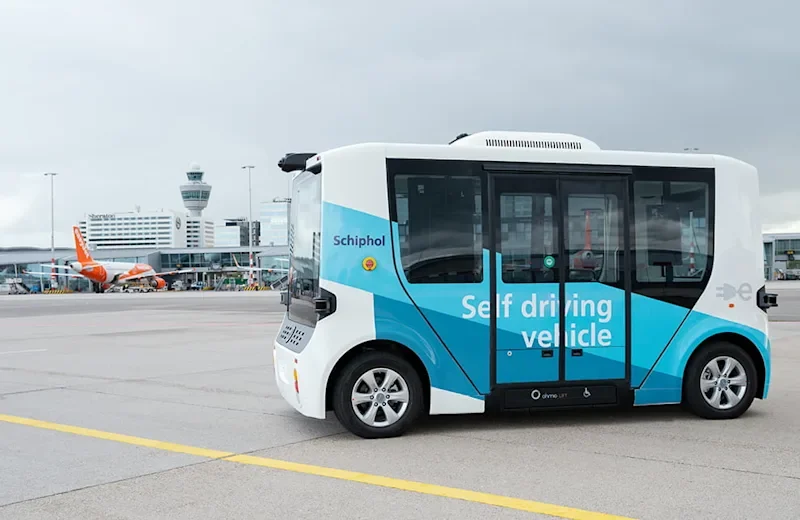
The autonomous shuttle bus
Our main goal with this innovative initiative is to validate the technological readiness of autonomous vehicles so they can seamlessly and safely integrate into a variety of airside scenarios. Schiphol’s mission is to demonstrate the value this new technology can add to the ecosystem and its partners.
Currently, RSG is leading bus operations at the airport. Given the size of Schiphol Airport, one of our top priorities is ensuring safe transportation for personnel from the Security Checkpoint (Gate 60) to their workplace, where they begin or complete their shifts. At Gate 60, employees from various companies rely on a daily shuttle bus service.
This route was chosen as the first test area because it is a Schiphol-managed service
concerns with a circular route and four stops. This allows us to experiment with different traffic levels, from busy peak hours to quieter times of day, creating an ideal environment for testing.
Schiphol conducted an extensive selection process to identify a vehicle that met the airport’s stringent requirements. The Lift vehicle, developed by Ohmio, emerged as the best option. This vehicle is a state-of-the-art autonomous shuttle that seamlessly integrates advanced technology with high-end safety features to deliver a reliable, safe transportation experience. It is specifically designed for autonomous operations, ensuring efficient navigation and smooth interaction within the airport environment.
Conclusion
Orchestrating (autonomous) traffic will not be realized overnight, but we do not want to sit still and wait. Therefore, we have divided our vision into three blocks and are starting to build on what is feasible in the short term: understanding the current situation and creating a holistic view for all airport users.
To achieve this, we evaluate different solutions to map traffic flows and collect additional traffic information. We then share this information with stakeholders to validate the value of a holistic view.
Want to know more? We worked on this!

Rahel de Vriend
Rahel de Vriend


