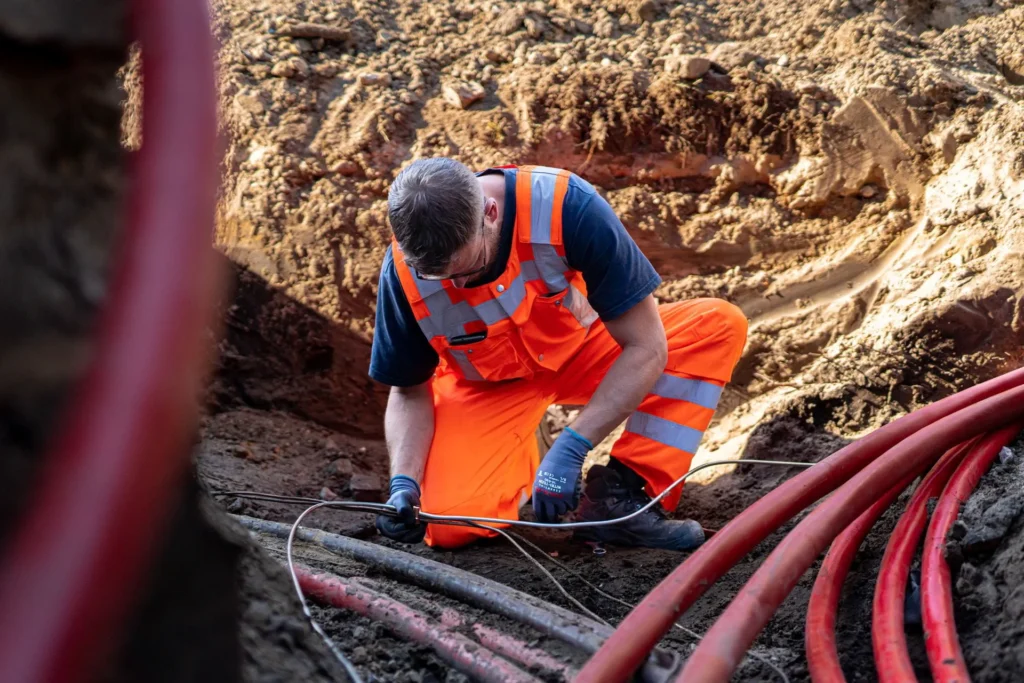
From trench to cable at Enexis: a big-bang go-live without data loss and record adoption in a complex chain

Challenge
In an industry where data migrations often fail due to complex chain structures, Enexis had to switch from trench to cable registration. Some 250 core users saw their way of working radically changed, while some 5,000 adjacent users would be impacted daily, and all of this had to be done without loss of production or data.
Result
A successful big-bang go-live with zero data loss, high adoption, and strong chain collaboration. A solid foundation has been laid for the next step: Revision Automation via NLCS++.
Client
Enexis is one of six regional grid operators in the Netherlands, responsible for the construction and maintenance of the gas and electricity grids. The migration to the cable model fell under the Asset Registration value chain.
In brief
The implementation of the cable model at Enexis was one of the most far-reaching chain changes within the energy sector. nlmtd led the migration from trench to cable registration in GEN, with direct impact on many stakeholders and multiple systems.
Through a combination of pragmatic execution, tight chain-of-command direction, and target-group-specific narrative communication, a big-bang go-live was achieved on June 11, 2025. With zero data loss, a training rating of 4.5/5, and a solid foundation for NLCS++, Enexis proved that even the most complex transformations are manageable.
The success was not only in the technology but also in the approach: with a clear and consistent change story, we reached and activated colleagues as well as chain partners. The method was considered best practice throughout Enexis. We can be proud of that: we have strengthened Asset Registration and laid a solid foundation for NLCS++ and Revision Automation.
- Wilco Overweg (Product Manager Ketenvernieuwing GV&N Enexis)
Challenge
The demand for cable registration
The existing trench registration of assets at Enexis has limited accuracy, uniformity, and automation possibilities. In addition, differences among branches, contractors, and systems such as GEN, Netplan, AutoCAD, and Lovion caused friction and inconsistent quality. Namely, data is currently recorded in different systems, shared via email, and then entered by hand. This is error-prone and can be simplified and made much faster with Revision Automation.
The new information-exchange standard NLCS++ (an extension of the national NLCS construction drawing standard for 2D design drawings) enables revision automation but also calls for a single uniform drawing method: cable registration.
A flawless transition
Automation delivers demonstrable productivity gains that align with the industry’s strategic task of “build, build, build.” Moreover, engineers already think and design in cables. In short, the move from trench registration to wires is necessary for future-proof cooperation in the energy transition.
The challenge was making this transition in one go, with no disruption to operations, no data loss, and high adoption across a chain where thousands of stakeholders depend on these systems every day, despite regional differences, contractor variation, and a release calendar with many dependencies.
Process
The implementation of the cable model was carried out in five phases and rested on a new way of working with three guiding principles:
- The chain as storyteller: focus groups grew into ambassadors, and communication became an ongoing change story that gave meaning to the move to the cable model.
- Confidence through transparency: Risks and differences between the North and the South were not brushed aside, but used as strengths and learning moments. Ambassador input was also visibly incorporated, building trust ahead of going live.
- Adoption from day one: involvement began with co-designing training courses with core users, support focused on sharing expertise through visual examples, and aftercare concentrated on working together on the first real cases.

Deepdive in the process
Phase 1 – Preparing
The project started with a thorough impact analysis. Sounding board groups identified risks, regional differences, and dependencies. The dry release notes thus turned into clear storyboards and visual instructions. In addition, each identified risk was assigned a concrete Plan B to ensure the organization was prepared for any scenario.
Phase 2 – Testing
In seven intensive days of testing, more than 40 realistic use cases were run, involving users from across the chain. This provided not only technical certainty, but also confidence. The test days served as learning days and a communication channel: insights were shared, mistakes were corrected, and successes were celebrated—the result: 100% GAT-go before going live.

Phase 3 – Training
Over the course of a month, some 250 contractor employees received full-day training across 10 sites and 2 production lines. GEN interpreters, and Lovion and drawing software users were trained via webinars and self-study. This training, co-designed with core users, emphasized practical examples, recognizable cases, and visual explanations—average rating: 4.5/5, exceptionally high for a technical transition of this magnitude.
Phase 4 – Going Live
On June 11, 2025, the cable model went live. Thanks to careful preparation, this day felt like confirmation, not experimentation. The chain knew what was coming and was ready.
Phase 5 – Aftercare
After going live, a warm hyper-care phase followed, with walk-in consultations, visible experts, and the introduction of the “Cable Newspaper” as an informative platform, which accelerated stabilization and enabled continuous improvement.
Accelerate adoption
The combination of testing discipline, appreciative training, visible support, and an engaging change story (usefulness, need, pride) turned users into ambassadors and
ambassadors into accelerators.
The North-South paradox: from problem to strength
The impact analysis revealed significant differences between the Northern and Southern sites in terms of culture and change-readiness, as well as the processes and systems used.
However, the differences were not a bug, but a feature: North provided speed, South guaranteed quality; together they created an implementation that was both fast and solid.
Results
The cable model implementation became a textbook example of how technology and people come together.
- Technical: zero data loss, no critical errors and a scheduled migration day with no disruptions. In addition, there is system harmony across GEN, Netplan, AutoCAD and Lovion.
- Human: a training rating of 4.5/5, walk-in consultations for optimization rather than firefighting, and users becoming ambassadors who drew colleagues along, creating a positive feedback spiral.
- Strategic: laid the foundation for NLCS++ and accelerated Revision Automation. Also, the introduction of the Map Committee and Chain Council provides future chain gates and release rhythms for scalable governance.
- Organizational: Contractor standardization via quality gates and new SLAs serves as a springboard for automation.
This was a tipping point: we not only introduced a new registration model but also laid the groundwork for uniformity and automation toward NLCS++ and Revision Automation. Adoption was built into the approach from the beginning, with training developed together with core users and support centered on recognizable practical examples.
- Twan Beeren (Product Owner Asset Registratie GV&N Enexis)
Lessons learned
The implementation showed that successful transformation is not about technology alone, but about trust, rhythm, and humanity. Governance turned out not to be bureaucracy, but psychology. Through openness and clear roles, formal bodies grew into a network of trust that accelerated collaboration. Testing was investing in trust. Seven days of testing provided technical certainty and support, and prevented panic. The hyper-care phase made the difference with visible support and walk-in consultations in the first weeks, which made
ambassadors. Standardization also worked because it remained human. Uniformity works when quality and collaboration take precedence over rules. Finally, communication was the connecting architecture. A single source of truth in timing and tone prevents friction and noise in a complex chain
Next steps
The next phase focuses on Revision Automation through NLCS++. From technical testing to operational pilots and controlled scale-up in 2026. In addition, the proven cable model approach will serve as the new standard and be used as a blueprint for future high-complexity, high-stakes chain transformations. Also, governance is evaluated along with the project in the product rhythm. This means more KPI steering and structural capacity planning.
Conclusion
The implementation of the cable model at Enexis proved that even the most complex chain transitions can be tamed. The research question was technical; the answer turned out to be human. With nlmtd’s experience, a technique that worked flawlessly was combined with intensive cross-functional collaboration and change management, so that progress and trust went hand in hand. Stakeholders became not spectators but change ambassadors, a team working together—the result: a new standard for how the energy sector transforms sustainably and with confidence.
Want to know more? We worked on this!

Robert van Andel
Robert van Andel

Timo Richardson
Timo Richardson